
Identify Who Owns a Custer County Property
Three Custer County records share the answer. CTAS gives the fastest owner-of-record lead, TerraGIS confirms which mapped parcel fits the address, and the Clerk/Recorder holds the deed that moved title. Work them in that order.
- Enter the street number, street name, city, or ZIP in the Custer County CTAS Web Portal.
- Copy the parcel number and owner name exactly, including letters and zeroes.
- Ask the Custer County Clerk/Recorder for the newest deed and any later correction affecting that parcel.
- Compare the grantee and legal description with CTAS before treating the result as current.
This route keeps a map label or tax mailing name from standing in as title proof. A Custer County deed settles the question.
Custer County Property Owner Clues in CTAS
CTAS offers more than an address box. Its filters cover property owner, parcel number, street number and name, city, ZIP, section, township, range, subdivision, tax code, property class, sale date, and sale price. The tax-year selector runs from 2000 through 2025. Always note that year beside an owner result, because the displayed name belongs to the year you picked.
The portal page shows the Custer County search controls. Open the live CTAS search yourself before relying on what the screen displays.
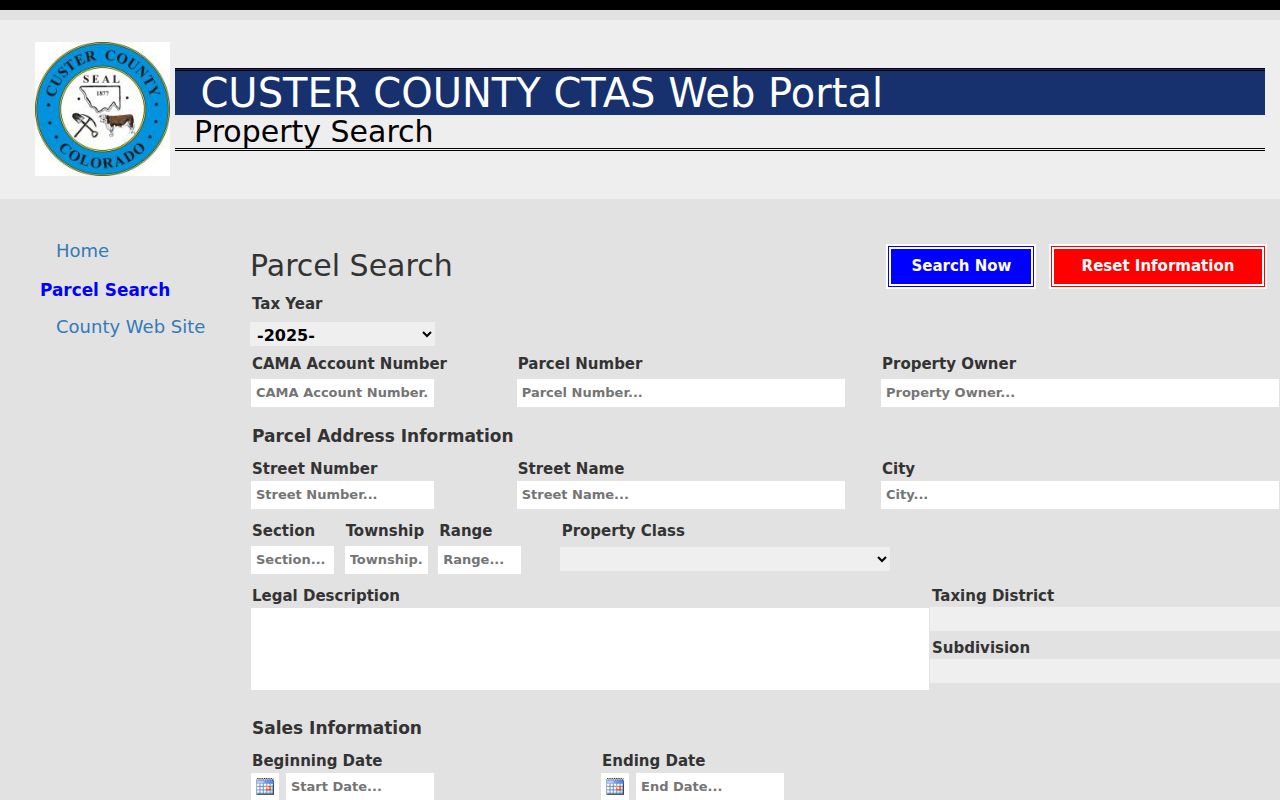
The portal confirms the search paths. Sample results vary by parcel and tax year, so read and date the live record yourself.
Sources That Trace to a Custer County Owner
No single source answers every question. This table separates the owner clue from the proof and the map context.
| Source | What It Adds | How to Reach It |
|---|---|---|
| CTAS assessment roll | Owner name, parcel and assessment-year context | Free web search |
| Clerk/Recorder | Latest deed, grantee, legal description and later instruments | Counter, phone or mail request |
| TerraGIS | Mapped parcel and nearby physical context | Free web viewer |
| Idaho SOSBiz | Entity record and registered agent when the grantee is a business | Free state search |
A Treasurer tax bill may carry a taxpayer name. That person or entity is not automatically the title holder in Custer County.
Confirm the Custer County Property Owner on Paper
The Custer County Clerk/Recorder records deeds, plats, surveys, easements, rights-of-way, mortgages, releases, and some liens. No grantor-grantee index appears online. A direct request is therefore normal practice. It is not a last resort.
Give the office the APN. Add the current CTAS name, a legal description if you have one, and an approximate transfer date, then ask for the most recent vesting deed plus later corrections. The courthouse sits at 801 E Main Street in Challis, and the Clerk's main number is (208) 879-2360.
- Owner of record
- The party named in the record currently used by an office.
- Grantee
- The party receiving the interest in a recorded deed.
- Vesting
- The wording that states how title is held.
- Situs address
- The physical property address, distinct from a mailing address.
Why Custer County Addresses Can Point Two Ways
A mailing city or ZIP is a postal route, not proof that a parcel sits inside Challis, Mackay, or Stanley. Rural E911 addresses can differ from the Assessor's situs. So can the owner's tax mailing address. Normalize the street spelling in CTAS first, then carry the APN into TerraGIS and the legal description to the Recorder. That cross-check keeps the chain honest.
Note: Keep compact Custer APNs exactly as written, because swapping a letter for a zero can point the search at a different parcel.
Trace a Custer County LLC, Trust, or Estate
LLCs appear often on the tax roll. Search any entity name in Idaho SOSBiz. A registered agent is a business contact, not the landowner. A trust name points back to the recorded deed and its vesting language. An estate can take an unsealed Idaho iCourt probate case and a personal-representative deed.
Keep the roles straight. The deed names the grantee, SOSBiz explains the business record, and the court file may explain authority to transfer, so no single source names the natural-person owner of record.
Check the Date Before Saying Who Owns in Custer County
Custer County posts no countywide schedule for how fast CTAS updates after a closing. A fresh deed can outrun the display. Write down the tax year you selected. Write down the day you viewed CTAS. Then compare both against the newest deed's recording date. If the names conflict, ask the Assessor and the Recorder instead of picking one.
Parcel splits need the same care. Idaho lets a transfer with unchanged boundaries keep its number, while a split creates child APNs, so search parent and child identifiers before assuming an owner vanished from the chain.
Limits of “Who Owns This Property” in Custer County
An assessment entry names an owner for one tax year. It does not show who occupies the land, rule out later deeds, settle easements, or replace a title search. Idaho's Address Confidentiality Program shields some address information. Never republish a protected residence.
Lawful use. Use Custer County property owner records for purchase diligence, boundary work, estate research, or civic questions. Never use them to stalk, harass, or harm a person.
Audit a Custer County Owner Conflict
When CTAS, a deed, and a tax notice show different names, keep all three rather than picking the familiar one. Log the basics. Record the assessment year, deed recording date, instrument number, and bill year. A fresh conveyance can lag behind the assessment roll. A trust, estate, life interest, or business name can also place parties in distinct official roles.
Then test the tract itself. Match the legal description. Compare the exact APN as well, to confirm every record concerns the same land. Ask the Assessor when the owner field changed. Ask the Recorder for later deeds and the Treasurer what role the billed name serves, and let that three-office check settle who owns a Custer County property without turning a taxpayer into title proof.